
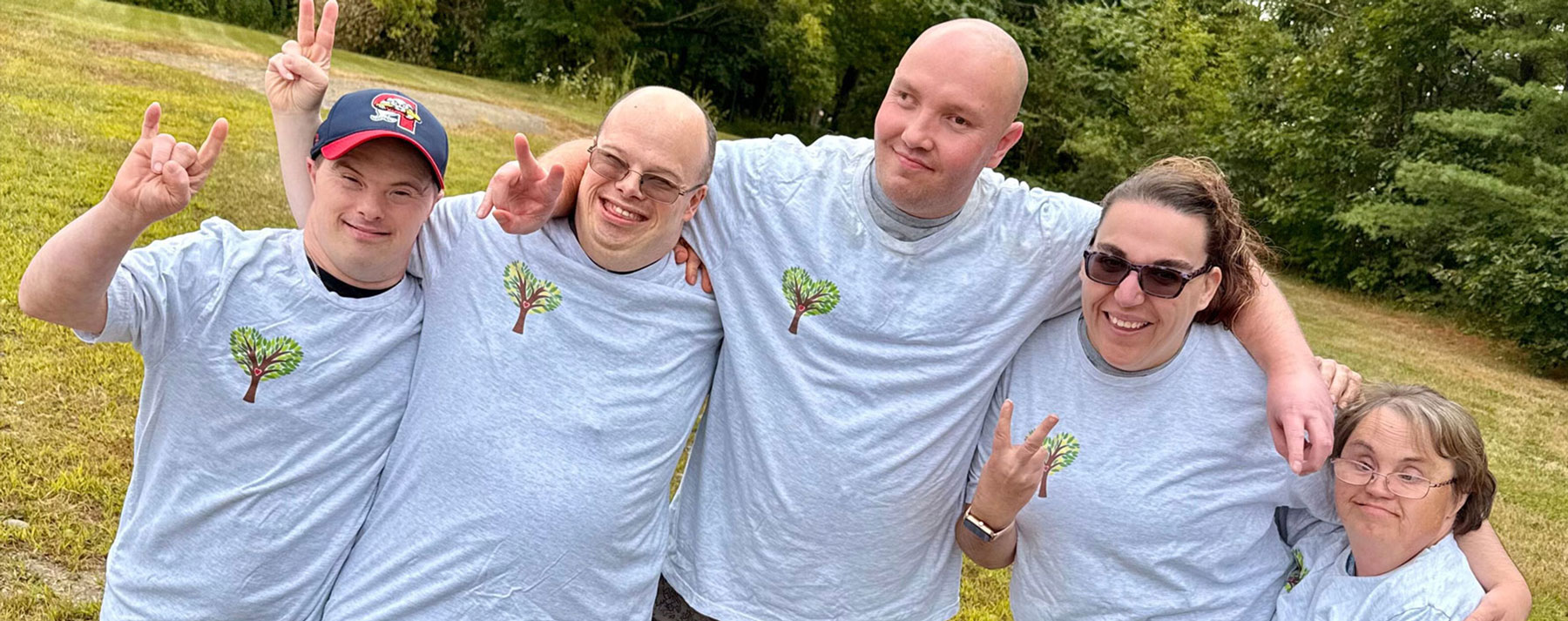


This summer, our athletes traveled to the Special Olympics Maine Summer Games. Approximately 65 athletes from our Hallowell, Gardiner, Skowhegan, and Waterville locations competed in the 50-, 100-, and 200-meter runs, the 100-meter walk, softball throw, shot put, mini javelin, long jump, and the relay.
Some of them medaled. Those who didn’t climbed onto the awards stand anyway — because after a year of training, showing up and competing is a win of its own.
None of it would have happened without a physical education researcher from Ontario who died this spring at the age of 96.
What Everyone Believed in 1960
For most of the twentieth century, the assumption about people with intellectual disabilities was simple, widely shared, and wrong: they were physically weak, they could not be trained, and low fitness was simply part of the diagnosis. Sport was not considered a possibility. In many places, neither was community.
Dr. Frank Hayden noticed what had escaped nearly everyone else — that the assumption had never actually been tested. Working at the University of Toronto in the early 1960s, he tested it. He measured the fitness of children with intellectual disabilities, put them through regular physical training, and measured them again.
His study found those children were roughly half as physically fit as their peers. It also found that structured training closed much of that gap. They got stronger. They got faster. The difference had far less to do with disability than with a simpler fact: no one had ever given them the chance to move.
A Book, 50,000 Copies, and an Introduction
He published his findings in 1964 — an academic work with sample lesson plans for teachers in the back, not the kind of thing that usually leaves a university library. It sold roughly 50,000 copies. Families bought it because it was the first document that told them plainly what many of them had suspected all along.
One copy reached Harry “Red” Foster, a Canadian broadcaster and advocate for people with intellectual disabilities, who brought Dr. Hayden’s work to Eunice Kennedy Shriver. Shriver — sister of President John F. Kennedy, whose own sister Rosemary had an intellectual disability — had been looking for someone who could turn conviction into evidence. She found him.
On July 20, 1968, about a thousand athletes gathered at Soldier Field in Chicago for the first Special Olympics. Almost no spectators came. Dr. Hayden helped organize those Games, later incorporated Special Olympics as a formal organization, and spent decades expanding it beyond North America, helping establish some 50 national programs worldwide.
Today, millions of athletes with intellectual disabilities compete in more than 170 countries. Dr. Hayden was appointed a Companion of the Order of Canada, inducted into Canada’s Sports Hall of Fame and Canada’s Walk of Fame, and in 2013 saw a Burlington, Ontario high school named in his honor. He died on May 16, 2026, in Oakville, Ontario.
Why This Isn’t a History Lesson
At Families Matter Inc, Special Olympics has been part of our programming as long as our doors have been open. Our participants train year-round and compete at regional and state levels. And the trip itself teaches something too — the packing, the traveling, the being away from home for a few days.
People sometimes describe Special Olympics as a nice thing we do. It is more specific than that, and Dr. Hayden is the reason we can say so with confidence.
Regular physical activity improves cardiovascular health, mobility, and weight management — outcomes that matter enormously for adults who face documented health disparities and a shorter average life expectancy. That’s why our athletes train and compete across the full calendar, from track and field to swimming, basketball, bowling, and Winter Games. Training toward a goal builds the planning and persistence that carry directly into a job, an apartment, a bus route. And competing in front of a crowd changes how a person sees themselves, and how a community sees them.
That last part was Dr. Hayden’s real finding. The research measured fitness. What it revealed was capability — and how much of it had gone unmeasured because no one thought to look. Anyone who watched our athletes climb onto that awards stand this summer already knows what he found.
Thank you, Dr. Hayden
Every athlete of ours who trained, traveled, and competed this summer did so because a researcher in Ontario declined to accept a claim that everyone else had stopped questioning.
We never met him. We owe him a great deal. Thank you, Dr. Hayden.
Support Our Mission → Your gift helps Maine adults with intellectual and developmental differences train, travel, and compete. To give your gift, please visit https://www.paypal.com/us/fundraiser/charity/1469401.